10 Rules For Writing Multiple Choice Questions
 This
is a back-to-basics article about the undervalued and little-discussed
multiple choice question. It’s not as exciting as discussing 3D virtual
learning environments, but it might be just as important. If you need to
use tests, then you want to reduce the errors that occur from poorly
written items.
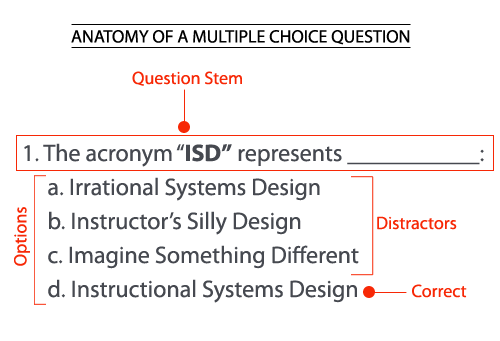
The rules covered here make tests more accurate, so the questions are interpreted as intended and the answer options are clear and without hints. Just in case you’re not familiar with multiple choice terminology, it’s explained in the visual below.
Rule #1: Test comprehension and critical thinking, not just recall
Multiple choice questions are criticized for testing the superficial recall of knowledge. You can go beyond this by asking learners to interpret facts, evaluate situations, explain cause and effect, make inferences, and predict results.Rule #2: Use simple sentence structure and precise wording
Write test questions in a simple structure that is easy to understand. And try to be as accurate as possible in your word choices. Words can have many meanings depending on colloquial usage and context.Rule #3: Place most of the words in the question stem
If you’re using a question stem, rather than an entire question, ensure that most of the words are in the stem. This way, the answer options can be short, making them less confusing and more legible.Rule #4: Make all distractors plausible
All of the wrong answer choices should be completely reasonable. This can be very hard to accomplish, but avoid throwing in those give-away distractors as it detracts from the test’s validity. If you’re really stuck, get help from your friendly SME. (BTW, this word can also be spelled as “distracter.”)Rule #5: Keep all answer choices the same length
This can be difficult to achieve, but expert test-takers can use answer length as a hint to the correct answer. Often the longest answer is the correct one. When I can’t get all four answers to the same length, I use two short and two long.Rule #6: Avoid double negatives
No big news here, right? Don’t use combinations of these words in the same question: not, no, nor, the -un prefix, etc. For example, this type of question could confuse test-takers: ‘Which of the following comments would NOT be unwelcome in a work situation?’ Flip it around and write it in the positive form: ‘Which of the following comments are acceptable in a work situation?’Rule #7: Mix up the order of the correct answers
Make sure that most of your correct answers aren’t in the “b” and “c” positions, which can often happen. Keep correct answers in random positions and don’t let them fall into a pattern that can be detected. When your test is written, go through and reorder where the correct answers are placed, if necessary.Rule #8: Keep the number of options consistent
Did you ever have to convince a SME that he or she can’t have answer choices that go to ‘h’ in one question and ‘c’ in the next? It’s something of a user interface issue. Making the number of options consistent from question to question helps learners know what to expect. Research doesn’t seem to agree on whether 3 or 4 or 5 options is best. Personally, I like to use 4 options. It feels fair.Rule #9: Avoid tricking test-takers
As faulty as they are, tests exist to measure knowledge. Never use questions or answer options that could trick a learner. If a question or its options can be interpreted in two ways or if the difference between options is too subtle, then find a way to rewrite it.Rule #10: Use ‘All of the Above’ and ‘None of the Above’ with caution
I hate this rule because when you run out of distractors, All of the Above and None of the Above can come in handy. But they may not promote good instruction. Here’s why. All of the Above can be an obvious give-away answer when it’s not used consistently. Also, the All of the Above option can encourage guessing if the learner thinks one or two answers are correct. In addition, the downside to None of the Above is that you can’t tell if the learner really knew the correct answer.This article I take from http://theelearningcoach.com/elearning_design/rules-for-multiple-choice-questions/


0 komentar:
Posting Komentar